
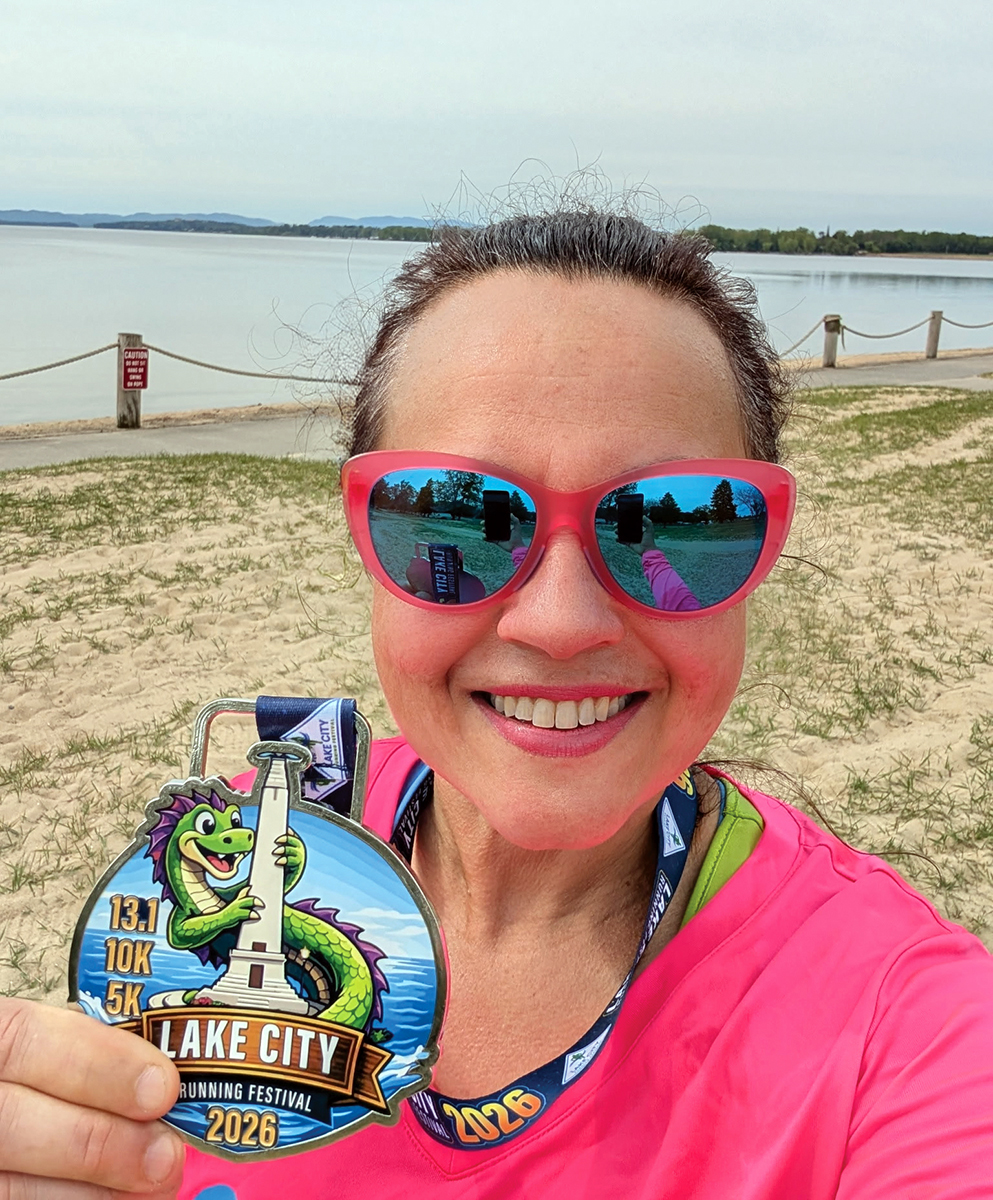
Aisha O’Donnell lifts three times a week and is about to complete her 48th half-marathon (one in each state). Her love of running led her to create the Burlington Running Club in 2017. But even O’Donnell needs the occasional pep talk from her coach. “Since you crushed that progression run on Tuesday, the goal today is zero strain” is one example. It’s solid advice, and it works. “I ran a much faster 10K than I have been running and got third in my age group,” O’Donnell says. But the advice didn’t come from a human coach. It came from Gemini, Google’s artificial intelligence assistant.
General backlash against the use of AI has been growing, according to the Pew Research Center, which found that half of American adults reported feeling more concerned than excited about the growing use of AI, up from 37 percent four years ago. But one area where the technology appears to be welcome is fitness. Roughly two-thirds of gym-goers said they used fitness tools that feature an AI component, according to one survey, and more than half used AI wellness apps daily.
“AI has definitely become a huge resource for individuals on their fitness journey,” says Laura Rush, an exercise physiologist and manager of the Capital Health Wellness Center in Pennington, NJ. Many fitness apps, including Strava, Freeletics, and Fitbod, have added AI tools that analyze your progress, track health markers, and provide personalized workouts and training plans. Wearable devices like the Apple Watch, FitBit, and Oura Ring also incorporate AI tools. So do smart body weight and kitchen scales that track your calories and macros. And of course, like O’Donnell, you can always turn to an AI chatbot and request a personalized training plan, nutritional guidance, or motivational support.
Rush points out that this can be a huge benefit for people who otherwise wouldn’t necessarily be able to afford or access an in-person trainer or coach. And there are other perks to using AI to help you reach a fitness or health goal. Not to mention the rush of earning a digital trophy on your Apple Watch when you hit a personal benchmark. But there are also some undeniable risks to using AI for fitness, especially for people who are not experienced.
“AI is an interesting tool. It’s a good reference tool. But is it a safe tool?” asks Anel Pla, a certified personal trainer at Five Point Zero Fitness in Guttenberg, NJ. “So much depends on the app, the prompts you give, and how accurate the information is.”
The Good, the Bad, and the Friendly
O’Donnell, who has been running since 2010, turned to AI at the beginning of this year to pick up her pace. “I wanted to get faster with my running because I had slowed down over the years,” she says. “I wanted to see if it could help me with training.” She had dabbled in AI before, using it to change up her lifting programs. “I have used a variety of things, but this feels easier to use and more personalized in some ways,” she says.
She acknowledges that AI’s advice isn’t perfect, though. “I have been using it to track my macros, and sometimes it forgets what my goals are or gets confused,” O’Donnell says. As an experienced runner, she has been able to spot when something is amiss. But beginners may not have that advantage. That’s one reason that experts caution newbies against relying heavily on AI coaching.
“You can plug anything into ChatGPT, and it will give you an outline,” says Rush. “But there are things that technology can’t provide. Some people don’t know when to go heavier or lighter with weight. AI’s not going to show them that, so there is a risk of injury.”
Pla, who has been training people for more than a decade, has seen this firsthand with some of her clients. She has also seen AI-generated training plans in which the names of the exercises are wrong or the information is outdated. “When it comes to exercise and the human body, I don’t feel like AI is there,” Pla says. “When you have a personal trainer, you have accountability. You have someone pushing you in a safe manner.”
An AI-generated training plan also may not push you hard enough. Chatbots have a reputation for being overly agreeable, so it may not come up with a plan that’s effective enough for you to see results.
Similarly, Pla and Rush say they’ve seen AI generate problematic nutrition advice. There are many variables involved with how many calories you should eat in a day, such as age, height, muscle tone, and activity level. AI tends to oversimplify and give an unrealistic and even dangerous calorie range. “You have to stay on top of AI to make sure it doesn’t forget what you’re targeting,” O’Donnell says. “Don’t be afraid to tell it that it is wrong.”
Inputs and Outputs
So much of what you can get out of AI depends on what you put into it, literally. Including all the relevant information in a chatbot prompt is important, says Pla. This can be especially true if you have any preexisting health conditions or take medication. This was the case for Caryl Harris, who lives in New Hope, PA. “I started using AI when I was diagnosed with osteoporosis and wanted a workout plan designed for me,” she says. Harris, a self-described “gym rat” for most of her life, likes that AI provided an array of alternatives. “I do go to a gym, but in the nice weather I like the convenience of working out at home,” she says. “AI gave me that option. I like that I don’t have to leave the house and can work out in my pajamas if I want.”
She used the Google Health app to create training plans geared toward bone health and strength. “It’s like checking in with a trainer each day,” she says. “It’s the same type of accountability on my end.”
AI can also be useful for developing training plans for places you’ve never been. When Princeton, NJ, resident Gina Giazzoni decided to take a four-day trip to hike the mountains of Eastern Europe, she knew she needed to prepare. “I’ve hiked for a long time, but this is a little more intensive than what I’ve done in the past,” she says. “I thought, It looks like there is a lot of uphill and elevation, and I live in New Jersey, so I need to figure out a way to get in shape. I don’t want them to leave me behind in the mountains in Slovakia!”
She had used apps in the past to track her distance and speed when training for a half-marathon, but this was terrain she had never set foot on. “I asked ChatGPT what to do for my training plan,” she says. In her prompt, she included where she lives and her current routine and asked for a month-by-month training plan and a week-by-week breakdown. “It seemed reasonable,” she says. “I don’t know that I would have come up with the different components, like increasing the time I spend hiking every week, have a long hike followed by a shorter one, and include stair workouts to strengthen my legs for the descents.”
The plan also suggested hikes in the area that have similar elevation as her destination and useful advice, like to break in her hiking boots and try trekking poles. And it included rest days. “It tells me when to take a break when I’m going too hard,” Giazzoni says.
As helpful as it was, the AI plan wasn’t foolproof. “It did make a mistake,” Giazzoni says. “When I got to May and looked at the plan, there was no strength training.” She asked the chatbot about the missing info, and it added it back in. But the idea that AI might overlook something that a human wouldn’t tends to be a recurring theme and underscores the need for oversight.
Ultimately, AI is a lot like any fitness tool. It can be useful when used the right way. “Technology can enhance accountability, tracking, and accessibility,” says Rush. “But in-person fitness provides human experience, support, and connection that many people need to thrive in their fitness journey.”
You have to stay on top of AI to make sure it doesn’t forget what you’re targeting. Don’t be afraid to tell it that it is wrong.



She What? Podcast




 Site by