
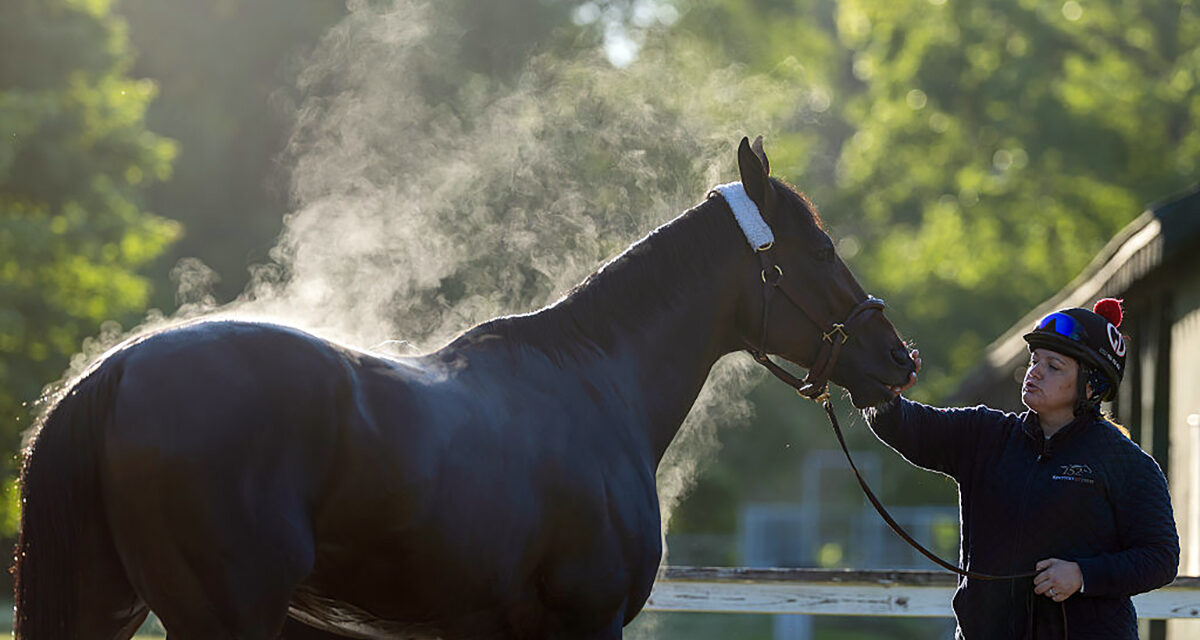
When sportswriter Dana O’Neil interviewed racehorse trainer Cherie DeVaux, who made Kentucky Derby history by being the first female trainer to win, they found common ground. Here are the revelations they discovered together.
We were sitting around a big conference room table inside a swanky suite that one of my reporter colleagues had somehow scored for the NCAA Tournament Final Four. It was well past midnight after the national title game, but in the time-honored tradition of sportswriter night owls too wired to sleep, we sucked down a few beers and rehashed the game.
As these things often go, the stories started spiraling into the ridiculous, and one of us told a hilarious, embarrassing story involving Taco Bell and a car with a white interior. Having reached the punchline, he suddenly looked up and spied me, the lone woman in the gathering, across the table. Aghast, he stopped: “Damn, Dana. I’m so sorry. I forgot you were here.”
I told him it was the nicest thing anyone had said to me all weekend.
I thought about that story in May when 44-year-old Cherie DeVaux, fresh off becoming the first female trainer to win the Kentucky Derby, told the Today show how she thought about her career. “I consider myself a horse trainer, and I just happen to be female,” she said. Replace “sportswriter” with “horse trainer,” and I have used that exact line countless times in my life.
To be clear, I am not equating myself to DeVaux. I was not the first in anything, not by a long shot. I am the beneficiary of the women who did the real work, the ones who knocked down locker-room doors and paved the way for the rest of us to follow. Nor am I famous. I hide in the shadows of a byline, perfectly content to exist in relative anonymity.
Yet I understood DeVaux’s point entirely. As a sportswriter, I have worked for three decades in a profession historically occupied by men. In the press room at a recent golf tournament I could count on two hands the number of women I saw around me. Being a woman in a field dominated by men brings challenges and occasional side glances. It can be exhausting at times because, despite the evolution of humanity, a few knuckle draggers still exist among us, like a coach who once suggested I was “too pretty to be a sportswriter.” Whatever that means.
It’s also easier sometimes. Men can be less complicated to work with than women. I spent a good 40 minutes talking with a colleague before it dawned on him that I cut my hair. Men do not care what I wear to work or if I wore it three weeks ago. If we’re being truly honest, while women can be each other’s greatest champions, they can also be the first to tear each other down.
But largely existing in this so-called man’s world is not something I think about. I do not take inventory, nor do I consider myself an outsider. I have worked hard to be respected for my work, my ethics, and my integrity. My gender? If I’m doing my job well, it really shouldn’t matter.
DeVaux and I talked about that when we chatted recently, sharing an odd sisterly bond over our perceived frat-house professions. “I always wanted to focus on my career, and using my gender as part of that conversation never really crossed my mind,” she says.
I’ve had people say to me, ‘I just wish I could be more like you. I wish I could say what’s on my mind.’ I don’t know why that’s the case. It doesn’t occur to me that I can’t.
I’m not going out of my way to hurt people’s feelings, but I take up as much space as I want, and I’m going to be as loud as I want, and if you don’t like that, then I’m sorry.
Born to Train
DeVaux was born into a horse racing family, which is not unusual in Saratoga Springs, NY. The track is a small universe unto itself, a charming throwback tucked into the equally charming town that surrounds it. Her dad raised and trained standardbreds and became a harness-racing driver. Three older brothers joined him, and Devaux’s younger sister followed her to the thoroughbred route.
DeVaux wasn’t told she could get involved in the sport in any pro-feminist way; more like the thought never occurred to anyone that she or her younger sister couldn’t do the same as the boys. This resonated with me as well—my mom and dad never sat down and gave me a pep talk when I came home midway through freshman year of college and declared my intent to be a sportswriter. They just nodded along.
Such casual indifference was nonetheless a gift. It allowed freedom and gave per-mission to both of us to never stop and worry about whether we belonged. We just blithely did our jobs, only stopping to consider that we didn’t fit in when we encountered someone intent on making us feel out of place. “I’ve had people say to me, ‘I just wish I could be more like you. I just wish I could say what’s on my mind,’” DeVaux says. “I don’t know why that’s the case. It doesn’t occur to me that I can’t. I’m not disrespectful. I’m not going out of my way to hurt people’s feelings, but I take up as much space as I want, and I’m going to be as loud as I want, and if you don’t like that, then I’m sorry.”
DeVaux and I were both fortunate that early in our careers, we were shepherded by male mentors who treated us as equals. For me, that was my first sports editor, Chris D’Amico, an ink-stained journalist who made me better without ever making me feel inadequate, and later an entire staff at the Philadelphia Daily News. I was the lone woman on staff, and no one seemed to care, and when I got pregnant with my first child, my sports editor concocted a plan so that I could be paid longer than the six weeks allowed—which he, a dad, thought was barbarically short—and then return to work with relative ease.
For DeVaux, it was Chuck Simon, similarly old-school in his profession but evolved in his thinking to not care about DeVaux’s gender. Simon spent 30 years in horse racing and saw potential in DeVaux but also knew the “wild child” had to get her act together. He guided her through it.
DeVaux started working for Simon as an exercise rider, but he happily threw her into the fire, sending her to Turfway Park in Florence, KY, on her own with some of his horses. He figured that her original job meant she needed no assistance. Turns out, he was right. She could handle it.
Perhaps the greatest myth for women in male-dominated professions is that the men are out to get us. The truth is, they can be our biggest supporters. I count my male colleagues not only as my friends but also as my champions. They have stood up for me, but more than that, they’ve never treated me differently. Just like the Taco Bell moment: They let me in without hesitation, making my gender a complete nonissue.
152 Years in the Making
Here’s where it gets sticky—when something happens beyond the norm, as it just did for DeVaux. She made history and deserves to be lauded for it. Horse racing is very much an old boys’ club. When horse breeder and owner Penny Chenery spoke optimistically about her horse in the 1970s, everyone largely dismissed her as naive—until Secretariat became the greatest horse of all time.
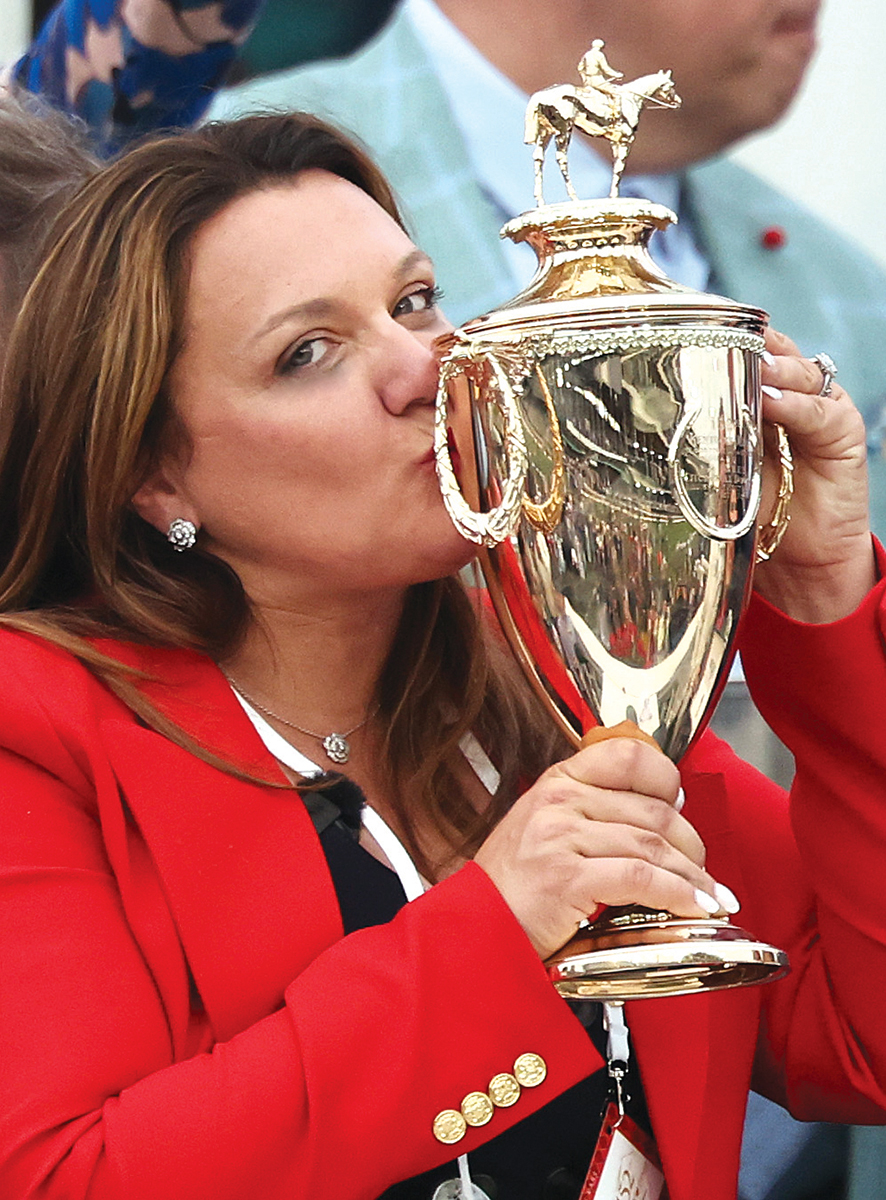
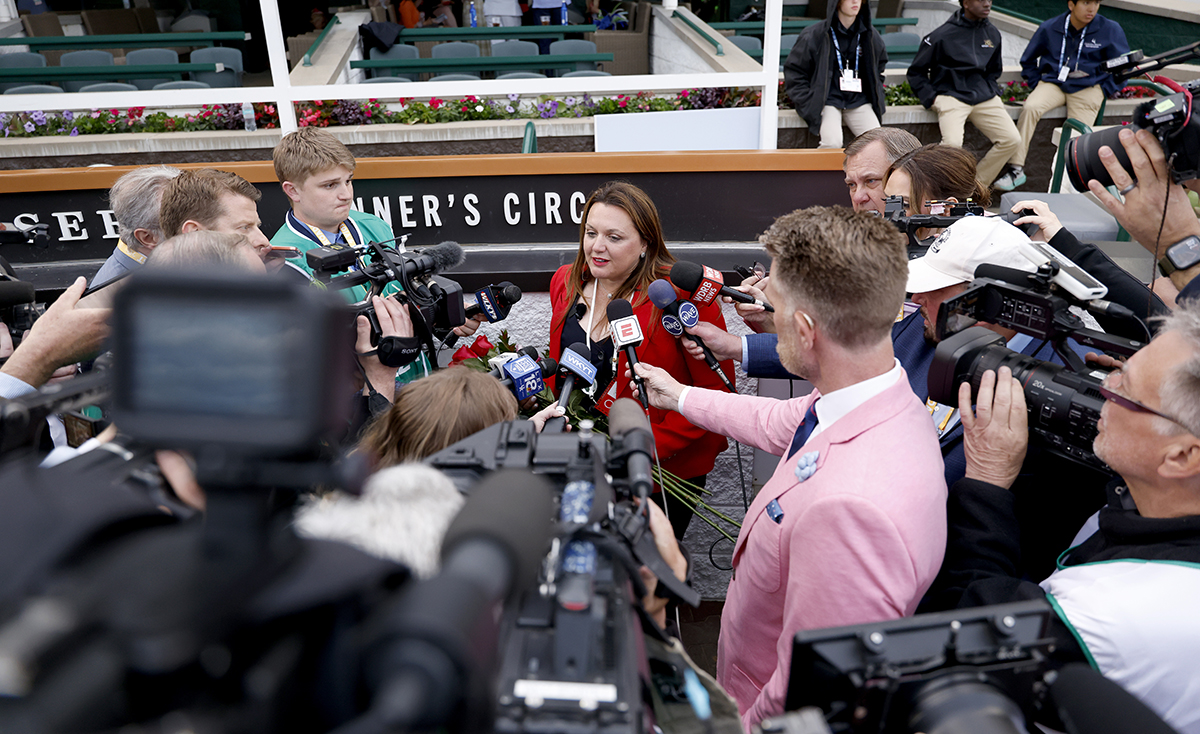
More than 2,000 horses have run in the Kentucky Derby; until Golden Tempo charged from dead last to first across the finish line, no female trainer had made it to the winner’s circle.
It was a moment 152 years in the making, and to not celebrate it would be foolish. DeVaux wisely said yes to every opportunity that came her way, recognizing not only that these moments don’t come along very often but also that she had an obligation to carry a torch, even if she didn’t ask to bear it.
But she does not want to be put in a separate pile. To predicate her success on her gender would minimize what she accomplished. I get that entirely. A number of entities hand out sports writing awards, and I’ve had female colleagues point out when a woman fails to make the list. I push back. I do not want to be someone’s token winner; I want to win a writing award because my writing was judged to be the best.
Think of DeVaux the same way. She did not take any shortcuts or handouts to get here. No one gave her the best horses because they wanted to give a woman a leg up. In 2018, she went out on her own as a trainer and promptly spent 11 months searching for a first-place finish. That first year was so demoralizing that DeVaux thought about quitting. Her husband, a noted bloodstock agent named David Ingordo, convinced her to stick it out, to give it at least three years. She hesitantly agreed.
And then the wins happened, slowly and steadily, and as it happens in the horse training business, wealthier owners sent her better horses. But they do not train themselves. DeVaux worked with each horse, treated it like the individual it is, and earned a reputation as a savvy trainer—not a savvy female but a savvy trainer.
Before Golden Tempo, her best horse was a filly named She Feels Pretty. DeVaux noticed early on in the horse’s career that she got nervous in her stable and showed signs of anxiety. Yet when she ran into another animal—one of DeVaux’s cats or a barn cat—she’d calm down. Against her better judgment, largely because she hates them, DeVaux got She Feels Pretty a goat named Mickey who she describes as “a butthead.” The support animal soothed She Feels Pretty so well that the filly never again finished out of the money in her races.
Similarly, Golden Tempo was hardly a favorite. His own jockey described him as “lazy,” and DeVaux says he needed time to mature. He won the Derby because his trainer figured out what was best for him. She intentionally planned a pre-Derby course to find races what would suit his closer nature and allow him time off to recover and figure out how to be a little faster. When he developed a cracked heel (think chapped lip) during the run-up to the big race, she devised a plan to treat him and not overwork him.
And after all of that, he was still a 23-to-1 long shot. “His running style is dependent on so many other things,” DeVaux says. “But I am such a whimsical thinker that I just thought, This is gonna work.”
There is now something of a bulls-eye on her back, she says. A downside to being a successful woman in a man’s world is that once success comes, everyone wants to know if it was a fluke. DeVaux is, in some ways, guarding against success. She has been intentional with every step of her career, particular about which owners she trains for and just how many horses she welcomes into her barn. Opportunity will now come knocking for her in ways it has never before.
She is prepared to only open the door when she’s ready. Temporary stardom has come at DeVaux hard and fast, but it does not mean she has forgotten how hard it was to get here. “I am a very grounded person,’’ she says.
“I don’t want to double what I have because that’s going to dilute the integrity and the quality of what I do.”
DeVaux also knows that fame is fleeting. She has a permanent spot in the history books, one she is immensely proud of, but soon sports, fans, and the world will be on
to the next.
Which isn’t such a bad thing.
“It’s not lost on me that it was a history-making moment,” she says. “But I also look forward to going back to my job and just doing what I do—not as a woman, just as a horse trainer.”



 Site by